Developing the Inner Life of Leaders
The foundation
My coaching approach is grounded in both professional practice and academic research. As part of my Master of Arts in Executive & Organizational Coaching at Royal Roads University, I explored a question that sits at the heart of my work:
What personal groundwork helps leaders develop greater self-awareness and, ultimately, become more effective human beings and leaders?
What emerged was a deeper understanding of something I had already been noticing in my work with clients: meaningful change rarely begins with tactics alone. It begins with understanding ourselves.
What the research revealed
The literature and leader interviews consistently pointed to one central theme:
Self-awareness is the foundation of effective leadership.
Leaders who better understand their thoughts, emotions, values, patterns, strengths, and limitations are more able to:
Navigate complexity with clarity
Regulate emotions under pressure
Build stronger relationships
Make better decisions
Lead with authenticity and integrity
Create healthier team cultures
These findings echoed both the Inner Development Goals (IDG) framework and the LEADS Leadership Framework, which place self-awareness at the centre of effective leadership development
Influence on my coaching
- What part of their identity is influencing this situation?
- What health or well-being factors are at play?
- How are they relating to themselves and others?
- What growth edge is trying to emerge?
The inner development model
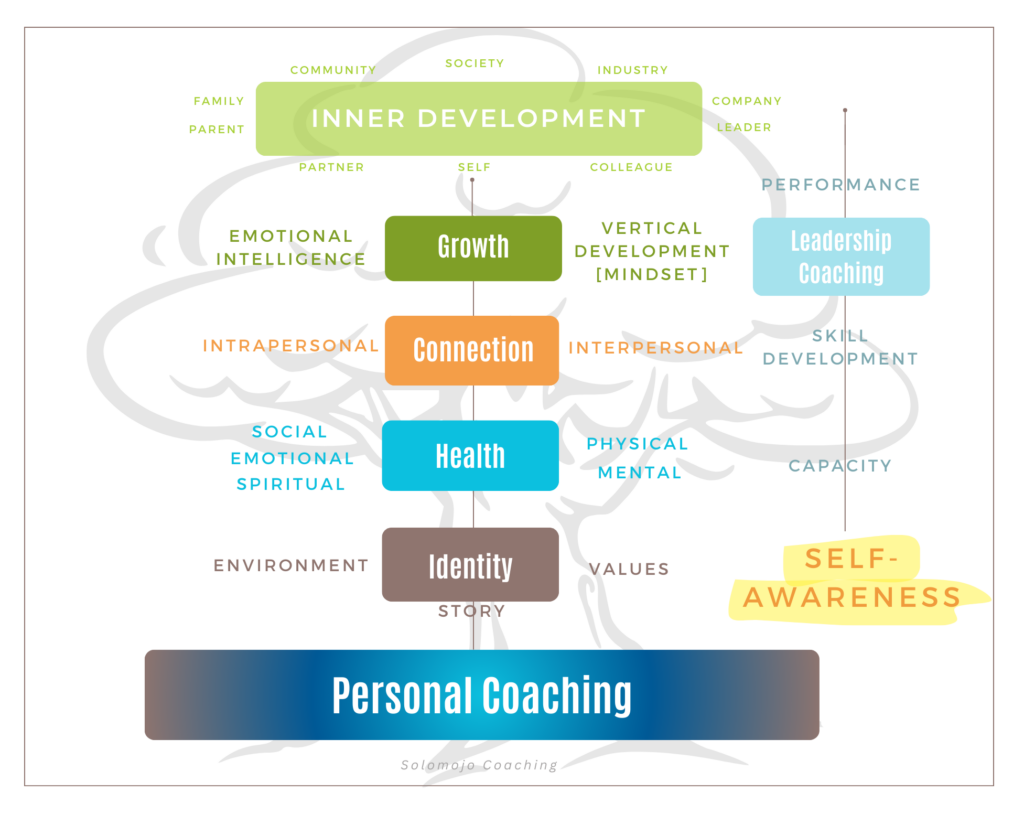
The outcome of my research was a practical framework organized around four interconnected domains.
At the centre of these four domains sits self-awareness, the capacity that helps us integrate learning and take meaningful action.
Identity – understanding who you are.
Personality
Personal story
Values
Environment and influences
Strengths and biases
Health – supporting the whole person.
Mental well-being
Emotional well-being
Physical well-being
Social well-being
Spiritual well-being
Connection – improving relationships with self and others.
Self-reflection
Self-compassion
Communication
Empathy
Trust and belonging
Growth – expanding how we think and lead.
Emotional intelligence
Growth mindset
Vertical development
Adaptability
Conscious leadership
Oak tree metaphor
- Roots represent identity and values.
- Soil represents health and well-being.
- Trunk represents connection to self and others.
- Branches represent growth and leadership impact.
- The whole tree reflects self-awareness in action.
For potential clients
Based on Jo Bennett’s MA research project, “Cultivating a Leader’s Inner Life Through Coaching: Groundwork for Increased Self-Awareness” (Royal Roads University, 2025).